 Introduction
Mining and aggregate processing are capital-intensive and high-load industrial projects. The overall productivity, finished product quality, operating cost, and service life of the entire production line are directly determined by equipment selection, standardized operation, and daily maintenance. Many quarry and mineral processing plants face common problems such as low output, frequent equipment failure, high energy consumption, and short machine service life, which are mainly caused by unreasonable model selection, irregular operation, and neglected daily maintenance.
A scientific matching scheme and complete maintenance system can effectively reduce downtime, improve production stability, and maximize project economic benefits. This blog will comprehensively sort out the core classification, professional selection principles, standard operation specifications, and daily maintenance strategies of mainstream mining and mineral processing equipment, providing reliable technical references for global mine investors and plant operators.
Common Types of Mining & Mineral Processing Equipment
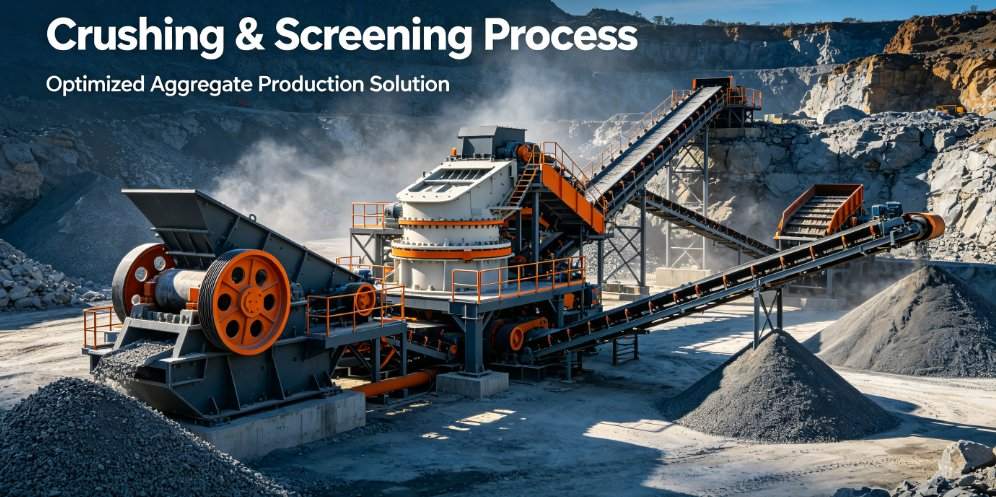
A complete mining processing line covers crushing, screening, grinding, separation, and conveying systems. Each type of equipment undertakes independent core functions and forms a coordinated production system.
1. Crushing Equipment
Crushing equipment is the foundation of aggregate and ore processing, used to break large raw stones into small-particle materials that meet feeding requirements for subsequent processing. Main models include jaw crushers, cone crushers, impact crushers, and mobile crushing stations. Jaw crushers are suitable for primary coarse crushing of high-hardness rocks; cone crushers are used for medium and fine crushing of hard ores; impact crushers focus on shaping and fine crushing of medium-soft materials.
2. Screening Equipment
Vibrating screens are responsible for material classification and closed-circuit circulation screening. They separate materials of different particle sizes, screen out qualified finished aggregates, and return unqualified oversized materials to the crushing system for reprocessing. High-performance thin-oil vibrating screens are widely used in large-scale mines due to their stable operation and low failure rate.
3. Grinding Equipment
Grinding mills are applied in fine mineral processing scenarios, grinding crushed ore into fine powder or micro-fine particles to liberate valuable minerals, creating conditions for subsequent separation and purification operations.
4. Gravity Separation Equipment
Represented by shaking tables, spiral chutes, and jig separators, gravity separation equipment sorts minerals according to specific gravity differences. It is the core equipment for processing gold, tungsten, tin, tantalum-niobium, and other rare metal ores, featuring low energy consumption and high separation accuracy.
Professional Mining Equipment Selection Principles
Blindly pursuing high-power or low-price equipment is the main mistake in mine equipment selection. The optimal solution must be matched according to material characteristics, output requirements, and working conditions.
1. Material Characteristic Matching
Different ores have different hardness, viscosity, and abrasiveness. High-hardness rocks such as granite and basalt are suitable for jaw + cone crushing combination; medium-soft rocks such as limestone and dolomite can adopt jaw + impact crushing scheme. For fine-grained rare metal ores, high-precision gravity separation equipment must be selected to ensure recovery rate.
2. Production Capacity Adaptation
Match equipment models according to hourly output and annual production scale. Small and medium-sized mines can choose integrated and compact production lines, while large-scale quarries need heavy-duty, high-throughput equipment to avoid equipment overload operation and insufficient production capacity.
3. Finished Product Standard Requirements
If the project requires high-standard cubic aggregate for highways and construction, shaping crushing equipment and multi-layer precision screening equipment must be configured. For mineral processing projects requiring high concentrate grade, high-precision separation equipment is essential.
4. Site and Environmental Adaptability
Consider site area, terrain conditions, and local environmental protection policies. Mobile crushing and screening equipment is suitable for frequent site migration and scattered materials; fixed production lines are more suitable for large-scale, long-term mining projects.
Standard Operation Specifications for Mining Machinery
Standardized operation is the key to avoiding equipment failure and improving production efficiency. All mining equipment must follow pre-start inspection, standardized operation, and shutdown maintenance procedures.
Pre-operation Inspection: Check equipment fastening parts, lubrication system, electrical circuit, and material feeding status to eliminate hidden dangers such as loose bolts, insufficient lubricating oil, and blockage in advance.
Running Operation: Prohibit overloading and starved operation; feed materials uniformly to avoid sudden large material impact and material accumulation. Monitor equipment vibration, temperature, and sound in real time during operation.
Post-shutdown Management: Clean residual materials inside the equipment, check wearing parts, and record daily operation data to provide basis for subsequent maintenance and parts replacement.
Daily Maintenance & Troubleshooting Guide
Mining equipment operates in harsh environments with heavy load, dust, and high vibration. Scientific daily maintenance can effectively extend equipment service life and reduce operating costs.
1. Lubrication System Maintenance
Lubrication failure is the main cause of equipment burnout and high temperature failure. For thin-oil lubricated equipment, regularly check oil level and oil quality, replace lubricating oil regularly, and ensure heat dissipation and lubrication effects. For grease-lubricated parts, replenish grease quantitatively to avoid dry friction.
2. Wearing Parts Inspection & Replacement
Crushing liners, screen meshes, hammer heads, and separation troughs are vulnerable wearing parts. Regularly check wear degree, replace severely worn parts in time, and avoid unqualified finished products and reduced production capacity caused by excessive wear.
3. Dust & Sundry Cleaning
Long-term dust accumulation will affect equipment heat dissipation and mechanical operation. Regularly clean equipment surface and internal residual materials to ensure smooth equipment operation and reduce failure rate.
4. Regular Equipment Calibration
For screening and separation equipment, regularly calibrate amplitude, frequency, stroke, and deck slope to ensure stable screening accuracy and separation efficiency, avoiding material mixing and low recovery rate.
Common Mistakes in Mining Equipment Operation & Maintenance
- Blindly increasing feeding volume to pursue output, resulting in equipment blockage and overload damage
- Ignoring daily lubrication inspection, leading to bearing high temperature and equipment shutdown
- Delayed replacement of wearing parts, resulting in reduced finished product quality
- Unreasonable parameter adjustment of screening and separation equipment, causing low processing efficiency
- Irregular shutdown and startup, accelerating mechanical fatigue and reducing service life
Conclusion
The comprehensive benefits of mining and mineral processing projects depend on reasonable equipment selection, standardized operation, and systematic daily maintenance. Excellent mining machinery can improve production efficiency, while scientific operation and maintenance management can effectively reduce failure rate, extend equipment service life, and control long-term operating costs.
Whether it is aggregate crushing and screening production or fine mineral gravity separation processing, targeted equipment matching and standardized management are indispensable. We provide global customers with one-stop mining equipment selection, scheme customization, operation guidance, and after-sales maintenance services to help every mine project achieve efficient, stable, and low-consumption production.